
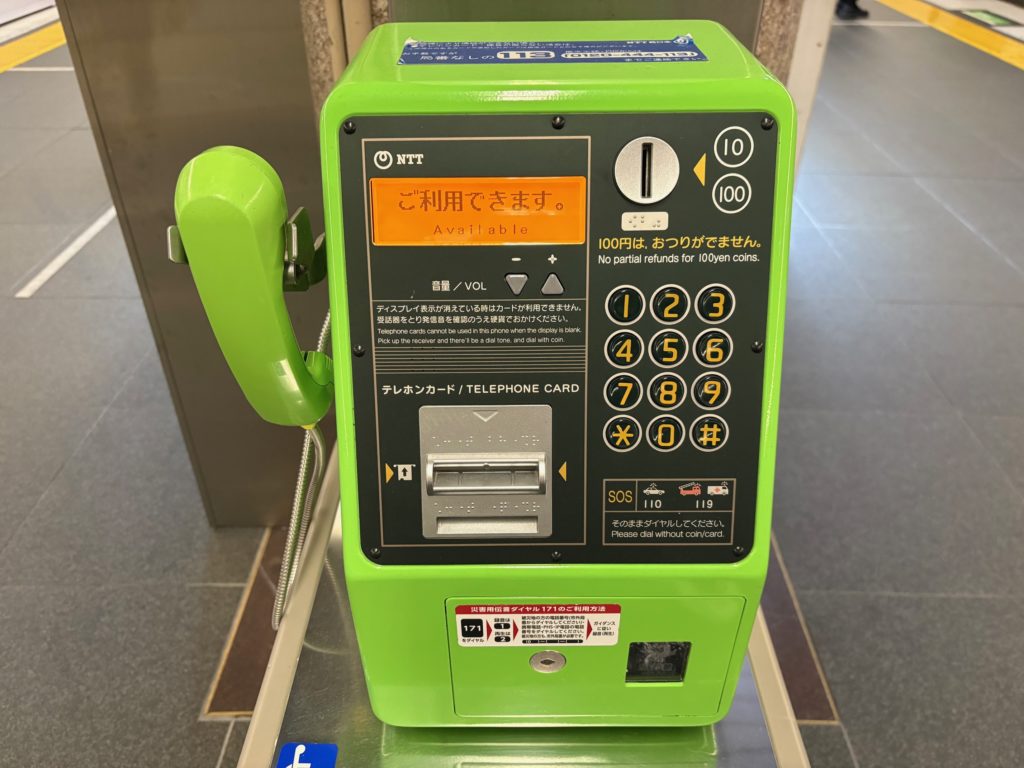
Payphones in Japan, like elsewhere, are rapidly disappearing. They’ve dropped from a peak of nearly one million units to just over 100,000 today.
Many tourists might see them as quaint relics of the past.
However, for travelers in disaster-prone Japan, the seemingly obsolete payphone is actually a vital piece of safety infrastructure—the ultimate backup when your smartphone fails.
This guide will explain why every visitor to Japan should know where to find and how to use this critical resource.
1. Why You Need to Know the Payphone (Kōshū Denwa)
In Japan, payphones are designated as part of the country’s “Universal Service”—a guarantee of minimum communication access for everyone.
While the number is planned to be reduced further to about 30,000 by 2031, the remaining units serve a crucial, life-saving purpose.
💡 The Payphone Advantage for Tourists
- SIM/Phone Trouble Backup:
Your pocket Wi-Fi runs out of battery, your international SIM card fails, or your phone gets lost or stolen.
When your primary communication tool is down, a payphone is your immediate, reliable connection to help. - Disaster Resilience:
Japan faces typhoons and earthquakes. During a major disaster, mobile networks often face “traffic overload” (congestion), making calls extremely difficult. Payphones are given priority connection status over general mobile calls, acting as your most reliable way to reach emergency services. - Works Without Power:
Most payphones are powered directly through the phone line itself, meaning they can function even during widespread power outages when charging your smartphone is impossible.
2. Emergency 101: How to Call for Help (It’s FREE!)
This is the most critical information for every visitor. Emergency calls from any Japanese payphone are FREE and do not require coins or a phone card.
| Emergency Number | Purpose | How to Call |
| 110 | Police (Incident, Crime, Accident) | Pick up the receiver and dial 110. |
| 119 | Fire/Ambulance (Fire, Injury, Sudden Illness) | Pick up the receiver and dial 119. |
| 118 | Coast Guard (Maritime Accident) | Pick up the receiver and dial 118. |
Important Note: If the payphone has a red “Emergency Button”, press it first before dialing the number.
In major cities, operators often provide multi-language support or use a translation service for emergency calls.
3. International Calls: Connecting Home
If your smartphone is dead and you need to contact your home country, the payphone can still help.
4. Special Disaster Tools: 171 and JNTO Hotline
In a massive disaster where mobile networks are down, these tools are essential:
| Tool | Number / Method | How It Helps Tourists |
| Disaster Emergency Message Dial | 171 | A voice bulletin board where people can record and listen to safety messages. If you are separated from your group, you can leave a message for them, or check if they left one for you. |
| Japan Visitor Hotline (JNTO) | 050-3816-2787 | Run by the Japan National Tourism Organization (JNTO), this 24/7 hotline offers support for accidents, illness, and disaster assistance in multiple languages (English, Chinese, Korean, and Japanese). |
Note: The 171 service is usually free from a payphone when activated during a major disaster.
5. 【Be Prepared!】Your Travel Checklist
You don’t want to be searching for a payphone during a crisis. Add this simple check to your travel routine:
- Check Near Your Hotel: When you check into your accommodation (hotel, Ryokan, or Airbnb), use a mapping app to find the nearest payphone and remember its location. (They are often located near large train stations, post offices, hospitals, and parks).
- Carry Small Change: While emergency calls are free, general calls require 10-yen or 100-yen coins (or a Telecard). Keep a small stash of 10-yen coins just in case your card and phone fail.
- Save Key Numbers: Save the JNTO Hotline (050-3816-2787) and the Emergency Numbers (110, 119) as contacts on your phone, even if you don’t have a Japanese SIM.
The days of the payphone as an everyday device are over, but in Japan, it remains a robust, culturally protected, and crucial piece of emergency infrastructure.
A quick moment of preparation now can ensure your safety when you need it most. Safe travels!
| 【PR】 Your trip planning is almost complete! Complete your preparation by securing the one guide that guarantees confident interactions and a truly respectful experience in Japan. [Get the Kindle Edition Now on Amazon] |