
| 【PR】 Making a trip to Japan? Don’t risk a cultural mistake! Your comprehensive guide to Japanese etiquette and greetings is essential for every traveler. [Get the Kindle Edition Now on Amazon] |
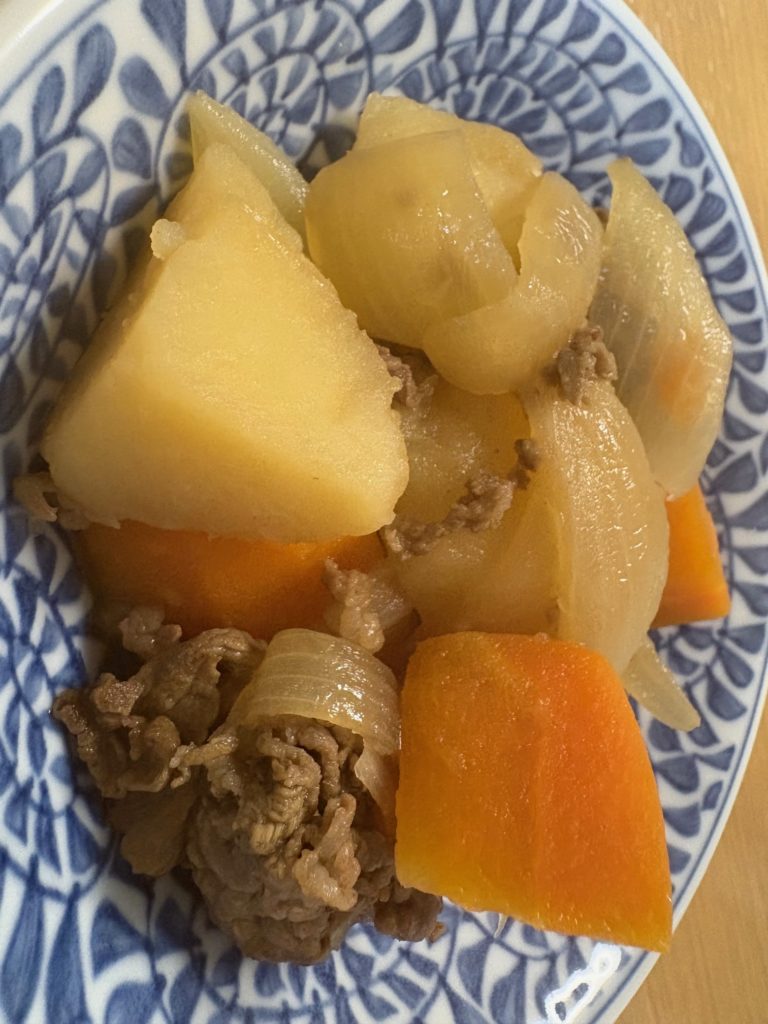
The undisputed king of Japanese home cooking is, without a doubt, Nikujaga (肉じゃが).
The perfect harmony of fluffy potatoes and simmered meat cooked in a sweet-and-salty sauce holds far more meaning than just a simple side dish.
It is a special presence, directly connected to warm memories and nostalgia—”I went back home,” “My mother made this for me” (Ofukuro ga Tsukutte Kureta).
However, have you ever noticed that this national dish is surprisingly rarely featured as a main item in typical Japanese restaurants or Teishoku (set meal) diners?
This phenomenon suggests that a uniquely Japanese value is deeply rooted: that Nikujaga is a “symbol of familial love” and “only truly delicious when made by a loved one who takes the time and effort.”
In this article, we will delve into the “why” and “history” of this essential dish on our tables, exploring its profound charm.
Chapter 1: A Romance Born from Foreign Flavors and Naval Ingenuity
The birth of Nikujaga dates back over a century, to the Meiji Era, starting with a truly romantic tale.
1. The Hero’s Unforgettable Taste of “Beef Stew”
The most compelling theory for the origin of Nikujaga is the “Imperial Japanese Navy Origin Theory.”
The main character of this story is Togo Heihachiro, the celebrated hero of the Russo-Japanese War. During his youth, while studying abroad in England, the taste of beef stew he ate there became unforgettable.
Upon returning to Japan, he commanded his naval chef: “Recreate that delicious beef stew for the sailors’ rations!”
2. The Miracle Substitution of Japanese Seasonings
However, in Japan at that time, Western condiments like demi-glace sauce—essential for beef stew—simply did not exist.
The chef struggled, but, relying on Togo’s hint that it contained “beef, potatoes, and carrots,” and utilizing the Japanese seasonings common at the time—soy sauce (shōyu) and sugar—he successfully created a substitute in the form of a nimono (simmered dish).
This process of transforming a foreign flavor with Japanese wisdom gave birth to the precursor of today’s Nikujaga, a naval ration known as “Aman-ni” or “Umani” (Sweet/Savory Simmer).
Today, the cities of Kure (Hiroshima Prefecture) and Maizuru (Kyoto Prefecture), where Togo Heihachiro was stationed, both lay claim to being the “birthplace of Nikujaga,” actively promoting the history of the dish and their regions.
Chapter 2: The Colorful “Birthplace” Debate and the Diversity of Nikujaga
Nikujaga was not born as a single, uniform recipe. The debate over its birthplace reveals the depth and regional character this dish possesses.
The two competing cities, Kure and Maizuru, not only claim the origin but also feature distinct differences in their local Nikujaga styles:
| Region | Characteristic Meat | Type of Potato | Flavor Tendency |
| Kure (Hiroshima) | Beef | May Queen | Less sweet, emphasizes the umami of the beef |
| Maizuru (Kyoto) | Beef | Danshaku (Russet-like) | Slightly sweeter, prioritizes a fluffy texture |
Expanding regionally, there is another key difference: Western Japan (a beef-eating culture) tends to use beef, while Eastern Japan (a pork-eating culture) typically uses pork.
This difference in meat alone changes the depth of flavor and the resulting richness of the broth, proving the saying: “There are as many flavors of Nikujaga as there are homes in Japan.”
Chapter 3: Hints for Making Nikujaga That Define Your Home’s Taste
The charm of Nikujaga lies in its simplicity, making it a dish anyone can easily make and adjust to their personal taste.
The choice of broth (dashi) alone—whether using a store-bought liquid dashi, or simply water and powdered dashi granules—can dramatically change the final flavor, adding to the fun of cooking.
【Simple Steps for Cooking Nikujaga (Hints)】
- Prepare Ingredients: Cut the potatoes, onions, carrots, your preferred meat (beef or pork), and shirataki noodles (optional konnyaku noodles) into bite-sized pieces.
- Sautéing Process: Heat oil in a pot, sauté the meat, and then add the vegetables to seal in their flavor.
- Building the Broth Base: Add the simmering base (traditional dashi stock, or water with dashi granules) and basic seasonings (sugar, soy sauce, mirin, and sake).
- Gentle Simmering: Skim off any foam and simmer gently over low heat until the vegetables are tender. Letting it cool down once will allow the flavors to truly penetrate, a highly recommended step!
Using these simple steps as a base, you can freely adjust the taste—making it “sweet,” “savory,” “light,” or “rich”—to perfect your own family’s signature “Taste of Home.”
Conclusion: Passing Down Warmth to the Next Generation
Nikujaga is a warm dish that embodies the condensed history and ingenuity of the Japanese dinner table.
The common understanding that “homemade Nikujaga is the best” speaks volumes about the value of love and effort embedded in this cuisine.
We encourage everyone to cherish this dish, filled with history and warmth, and pass it down as your unique family flavor.
—And if you are looking to elevate your everyday Nikujaga, or add depth and creative twists to your family’s flavor…
We are currently writing a special e-book dedicated to mastering Nikujaga, diving deep into the “why” of cooking and ingredient selection, far beyond a simple recipe.
We promise it will be a book that changes your perception of Nikujaga. Please look forward to its release!
| 【PR】 Your trip planning is almost complete! Complete your preparation by securing the one guide that guarantees confident interactions and a truly respectful experience in Japan. [Get the Kindle Edition Now on Amazon] |