
| 【PR】 Making a trip to Japan? Don’t risk a cultural mistake! Your comprehensive guide to Japanese etiquette and greetings is essential for every traveler. [Get the Kindle Edition Now on Amazon] |
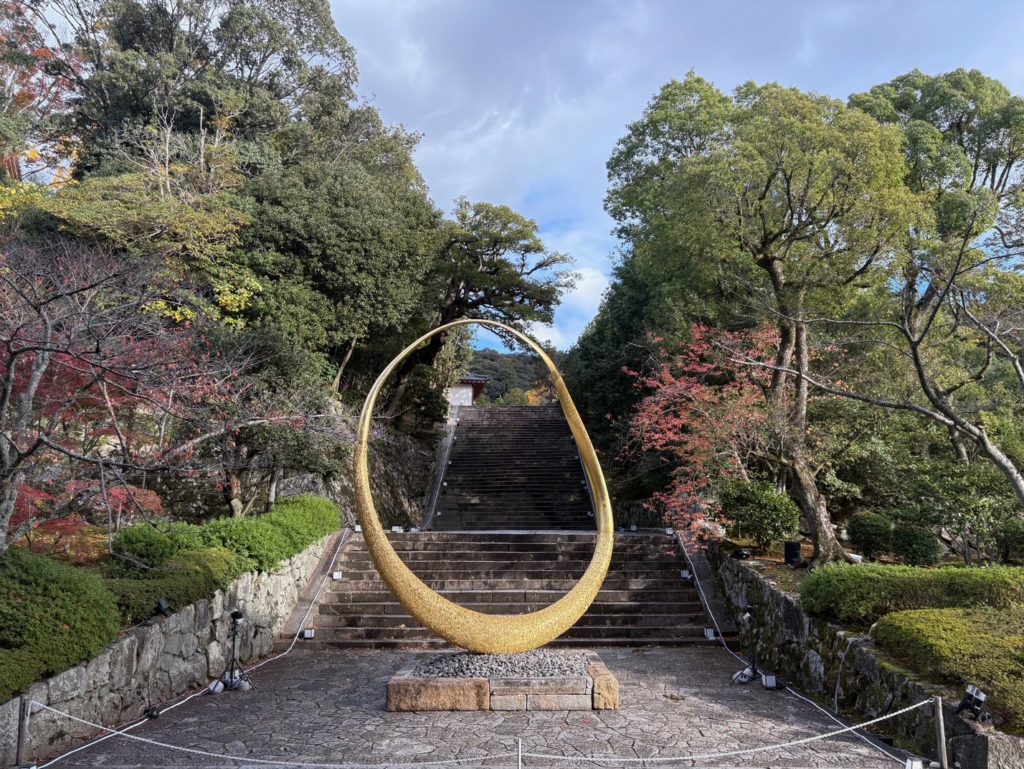
As the excitement of Expo 2025 Osaka, Kansai fades, a striking piece of the event’s legacy has found a surprising new life in an ancient setting.
The giant circular monument, “Magnus Rinn,” which stood prominently at the Ireland Pavilion at the Expo site (Yumeshima), was officially relocated to the grounds of Chion-in Temple—the head temple of the Jodo Pure Land Sect—in Kyoto on the afternoon of November 14, 2025.
Why was a contemporary international artwork welcomed into a solemn, historic Japanese temple?
We delve into the message of this spectacular, yet harmonious, fusion that embodies the concept of a “Place Where Time Flows.”
🇮🇪 The Significance and Form of the “Great Circle”
A Gilded Twist of Bronze and Oak
The “Magnus Ring” is a monumental sculpture by the renowned Irish artist, Joseph Walsh, standing approximately six meters tall.
- Meaning of the Name: “Magnus” means “great” in Latin, while “Rinn” is a Gaelic word (official language of Ireland) meaning “place” or “point,” which simultaneously suggests the Japanese words for “ring” or “circle.”
- Materials in Dialogue: The lower half is crafted from weighty bronze, while the upper section utilizes beautiful and highly durable oak wood.
The entire surface is meticulously covered in gold leaf, allowing it to shimmer regally in the sunlight. - The Secret of the Form: Though appearing as a perfect circle from a distance, upon closer inspection, one can perceive a “flexible twist” in its form. Walsh explains that this subtly contorted ring represents the very essence of a “place where time flows.”
This work, which radiated energy during the Expo, is now transforming its ephemeral brilliance into a sense of permanence within the quiet reverence of the ancient capital.
🤝 Cultural Resonance: The Special Connection that Led to Kyoto
How did a piece of contemporary art from an international exposition come to reside at Chion-in? The story lies in a deep-rooted, cross-cultural connection between those who uphold the traditions of both Ireland and Japan.
International Exchange and the Japanese Traditional Space
The relocation was made possible through a special bond of cultural trust and long-standing exchange cultivated between the Japanese expert responsible for the Expo’s Ireland Pavilion landscape design and the personnel involved in managing Chion-in’s historic gardens.
This international interaction between artisans and artists provided the foundation for the monument’s move.
Artist Joseph Walsh himself was deeply fascinated by Japan’s traditional spaces of “Sei” (stillness and tranquility). Upon visiting Chion-in and its vast, well-maintained grounds, he immediately felt that this very location was the ideal setting for his work—a place truly fitting to represent “where time flows.”
The decision marks not just a physical transfer, but the beginning of a cultural dialogue where modern Irish sculpture is formally embraced by Japan’s traditional aesthetics and sense of space.
⛩️ Spatial Design and Artistic Intent: The Calculated Placement
The “Magnus Ring” has been installed directly in front of the Otokozaka (Steps)—the steep stone steps leading up to Chion-in’s iconic, National Treasure Sanmon Gate. This positioning is loaded with meaning.
Art at the “Kekkai” (Boundary)
Chion-in Temple staff emphasized that the Sanmon Gate serves as a “Kekkai,” a sacred boundary separating the secular world from the spiritual realm of the temple.
They expressed hope that visitors, as they pass through this boundary and face the Otokozaka with the “Magnus Ring” before them, will feel the message the sculpture conveys. Observing the work here is, in a sense, experiencing the legacy of the Expo and its hopes for the future of humanity.
A Precise Tilt to Maximize Light
The expert who oversaw the installation carefully calculated the temple’s topography and sunlight.
The ring is not placed parallel to the approach; instead, it is tilted slightly towards the north-south axis.
This intentional alignment ensures that the morning light and the evening sun reflect dramatically off the gold leaf surface, allowing visitors to fully appreciate the sculpture’s radiance and the profound sensation of passing time.
Here, the monumental presence of Japan’s traditional architecture meets the shining vitality of contemporary international art in perfect harmony.
📅 Experiencing Chion-in and the “Magnus Rinn”
The exhibition of the “Magnus Ring” is scheduled to run until the end of September 2026, held in custodianship by Chion-in at the request of the Irish government.
- 【Period】 Mid-November 2025 – End of September 2026 (Scheduled)
- 【Location】 In front of the Sanmon Gate, Otokozaka (Open 6:00 AM – Close 4:00 PM)
Furthermore, Chion-in plans to illuminate the “Magnus Ring” during its special Autumn Nighttime Light-Up (scheduled from November 19 to December 7, 2025). Visitors can experience its ethereal, glowing presence against the backdrop of the night sky and illuminated autumn leaves.
The Majestic Charms of Chion-in
Take this opportunity to explore the history and culture of Chion-in, the head temple of the Jodo Pure Land Sect:
- The National Treasure Sanmon Gate: Measuring 24m high and 50m wide, it is the largest wooden gate in Japan.
Its imposing grandeur is a work of art in itself. - The National Treasure Mieidō Hall: The magnificent main hall enshrines the statue of the founder, Honen Shonin.
- The Seven Wonders: The temple grounds hold various legends, including the “Uguisu-bari” (Nightingale Floor) corridors that chirp when walked upon, and the “Wasure-gasa” (Forgotten Umbrella) tucked into the eaves of the main hall.
Gazing intently at the “Magnus Ring” encourages us to step away from the bustle of the modern world and find the mental space to contemplate the simple act of “being there.”
The Expo’s legacy has met Kyoto’s profound history and begun to mark new time. We highly encourage you to witness this unique collaboration in person.
| 【PR】 Your trip planning is almost complete! Complete your preparation by securing the one guide that guarantees confident interactions and a truly respectful experience in Japan. [Get the Kindle Edition Now on Amazon] |