
| 【PR】 Making a trip to Japan? Don’t risk a cultural mistake! Your comprehensive guide to Japanese etiquette and greetings is essential for every traveler. [Get the Kindle Edition Now on Amazon] |
Why are there statues with red bibs and hats on the roadsides of Japan?
Introduction
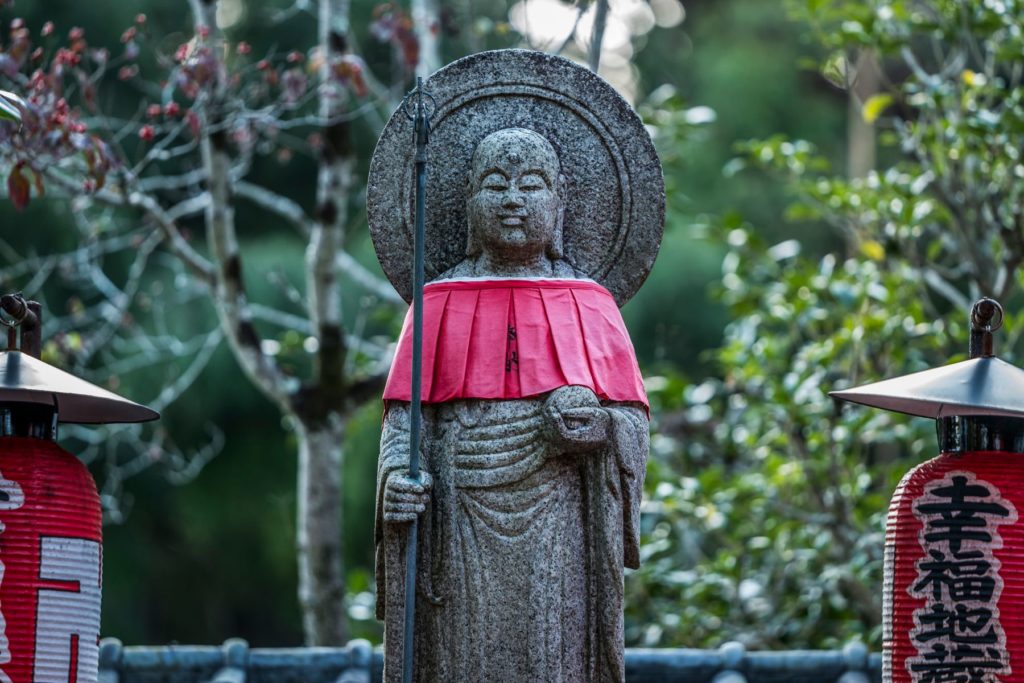
When traveling through Japan, do you often spot small stone statues, often adorned with charming red hats and bibs, on street corners, beside roads, or even in the quiet corners of Shinto shrines?
This figure is the Jizō (地蔵), formally known as Jizō Bosatsu (地蔵菩薩, Kṣitigarbha Bodhisattva), arguably the most familiar and beloved Buddhist figure in Japanese daily life.
Behind their simple appearance lies a profound history of compassion, a complex blend of Buddhism and Shintoism, and the earnest wishes of the Japanese people.
This article will reveal Jizō’s true identity, why they are so loved, and what the unique items they wear truly symbolize.
1. Jizō’s True Identity: The Great Savior of Buddhism
Jizō Bosatsu is a key figure in Mahayana Buddhism, originating in ancient India.
Jizō’s primary mission is of vital importance: to act as the savior of all suffering beings during the long period between the passing of the historical Buddha (Shakyamuni) and the arrival of the future Buddha (Miroku Bosatsu).
Jizō is believed to tirelessly travel through the Six Realms of Transmigration (Rokudō ̄, 六道)—including the realms of hell, hungry ghosts, and humans—to guide and rescue everyone stuck in the cycle of suffering.
The Guardian of Children
Jizō’s profound popularity in Japan stems from their role as the “Guardian of Children.”
According to traditional Japanese belief, children who die before their parents are unable to cross the Sanzu River (the equivalent of the Styx). Instead, they are forced to eternally stack pebbles at Sainokawara (賽の河原), a riverbed where demons constantly destroy their towers. Jizō is the only one who intervenes, protecting these lost souls, gently embracing them, and guiding them to the Pure Land.
This compassionate role solidifies Jizō as the focus of countless parental prayers.
2. A Fusion of Faith: Jizō as the Local Protector
Although Jizō is a Buddhist Bodhisattva, the reason they are enshrined outside of temples on roadsides relates to a unique cultural history where faith converged.
The Legacy of Shinbutsu Shūgō
The fusion of indigenous Japanese Shintoism and imported Buddhism, known as Shinbutsu Shūgō (神仏習合), was the norm for over a thousand years.
- Boundary Guardianship: Traditionally, Japanese villages set up Dōsojin (道祖神)—Shinto deities—at village borders to ward off calamity, disease, and evil spirits.
- Role Succession: Over time, Jizō absorbed the role of the Dōsojin. Jizō was enshrined at crossroads (tsuji) and borders as a protector of the community and a guardian of travelers, which is why you often see them near busy roads for traffic safety.
The Statues That Remain in Shrines
You may occasionally spot a Jizō shrine (Hokora) inside a Shinto shrine (Jinja) compound.
This is a rare yet powerful example of history.
When the government mandated the separation of Shinto and Buddhism in the Meiji period (1868) with the Shinbutsu Bunri (神仏分離) Edict, locals often insisted on protecting these statues.
Because they considered Jizō their indispensable local guardian, these statues were secretly moved or preserved in quiet corners, standing as a living testament to the power of folk faith over official decree.
3. Finding Jizō: The Difference Between Hokora and Roza
To spot Jizō statues during your travels, it helps to know the two main ways they are enshrined.
| Japanese Term | English Meaning / Appearance | Tips for Spotting |
| Hokora (祠) | A miniature, often wooden or stone structure (a small shrine/shelter) where the statue is placed. It protects Jizō from the elements and denotes a more formal reverence. | Warning: The statue may be hard to see inside the small structure. Look closely for a small roof and an interior with a glimpse of a red bib—that’s your Jizō! |
| Roza (露座) | The statue stands directly exposed to the open air, weathering the rain and sun without a surrounding structure. | These are often found on open roadsides or at intersections. |
The presence or absence of a Hokora primarily reflects the community’s way of showing care, and the effort put into organized maintenance by local residents (such as neighborhood associations).
4. The Deep Meaning of the Red Adornments
The hats, hoods, and red bibs that Jizō wears are not mere decoration; they are filled with profound symbolism and heartfelt prayers.
| Adornment | Symbolism and Cultural Context | The Core Wish |
| Red Bibs (Yodarekake) | Symbol of a child: The bib represents a baby’s clothing, offering a form of perpetual Kuyō (供養, memorial service) to children who passed away too soon. The color red is also historically associated with Amulets and Protection against evil spirits. | A prayer for the salvation of deceased children and the healthy growth of living children. |
| Hats / Hoods / Kasa | A gesture of human Compassion (Jp: itawari). The act is inspired by the famous folktale “Kasajizō” (笠地蔵), where a kind elderly couple gives their straw hats to Jizō statues freezing in the snow. | Showing gratitude to the Bodhisattva and wishing them comfort from the rain and cold. |
It is common to see handwritten messages on the bibs, containing wishes like “May this illness be cured,” or “Thank you for the safe birth of my child,” demonstrating Jizō’s role as the most approachable figure for personal vows and prayers.
5. Jizō’s Role by Location
Jizō’s function is often determined by where they are enshrined:
| Location | Primary Role | Purpose of Worship |
| Inside a Temple | Primarily for Mizuko Kuyō (水子供養, memorial for aborted or miscarried fetuses/infants). | To ensure the peaceful repose and salvation of these young souls. |
| In a Graveyard | Often enshrined as a set of six statues (Roku Jizō, 六地蔵) to guide the deceased through the Six Realms. Also common for individual Mizuko Kuyō. | To ensure ancestors do not suffer and to guide all souls to enlightenment. |
| Street Corner/Roadside | Local Guardian (Dōsojin role), and protector of travelers and traffic safety. | To ward off daily misfortune, prevent accidents, and maintain community peace. |
Conclusion
Next time you see a Jizō statue in Japan, whether standing exposed on a roadside or tucked away inside a small, quiet Hokora, take a moment to look beyond the stone. You are witnessing a powerful symbol of Japanese compassion, history, and community resilience—a beloved, humble savior who quietly watches over the souls of children and the safety of all those who pass by.
| 【PR】 Your trip planning is almost complete! Complete your preparation by securing the one guide that guarantees confident interactions and a truly respectful experience in Japan. [Download the Essential Etiquette Guide] |