
| 【PR】 Making a trip to Japan? Don’t risk a cultural mistake! Your comprehensive guide to Japanese etiquette and greetings is essential for every traveler. [Get the Kindle Edition Now on Amazon] |
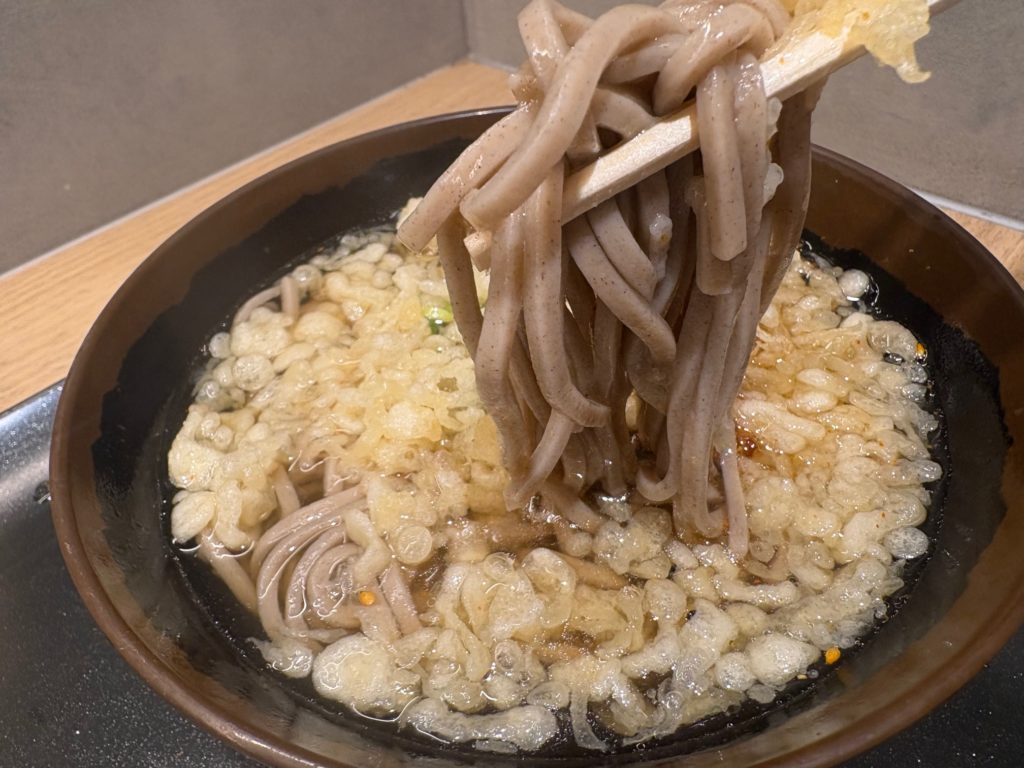
It is an everyday sight in Japan: people slurping noodles with a loud “zzzztt” sound when eating soba or ramen.
This ordinary scene for us often surprises foreigners who see it for the first time, sometimes causing them to raise an eyebrow.
Slurping noodles with sound is a unique Japanese food culture.
🌍 The Major Difference in Noodle-Slurping Manners Around the World
Let’s look at dining manners in the West. Eating pasta with sound is considered a breach of etiquette.
Making noise while eating is regarded as “vulgar,” and the fundamental rule is to eat quietly.
This applies not only to pasta but also to soup, which should be consumed without slurping or making any sound.
What about Asia?
Even in China, where noodles are also popular, people rarely slurp them.
They use a renge (Chinese spoon) to scoop the noodles and put them into their mouth.
Similarly, in Korea, making noise while eating noodles is considered poor manners, and the same applies to various countries in Southeast Asia.
Slurping noodles with sound.
This appears to be a habit unique to the Japanese.
It is thought that the background for this lies in the soba culture of the Edo period.
The soba that became popular in the Edo period—such as stand-up eating and night-stall soba—was a form of fast food intended to be eaten quickly and swiftly.
When eating quickly and swiftly, people would slurp soba with sound.
By drawing the soba into the mouth along with air, the aroma of the soba passes through the nose, allowing one to fully appreciate the flavor.
It was also an effective way to cool down piping hot soba while eating it.
Eventually, loudly slurping soba with a “zzzztt” sound became established as the “chic” way for an Edokko (person from Edo) to eat soba.
This Edo culture then spread throughout Japan, and it became commonplace for Japanese people to slurp soba and udon with sound.
Key Takeaway in a sentence:
The Edo Period was a 260-year by the Tokugawa Shogunate, named after their capital city of Edo (Tokyo).
🌏 How Should Ramen, Which is Spreading Worldwide, Be Eaten?
Vigorously slurping noodles with sound is standard in Japan, but it remains an act that foreigners may perceive as a breach of etiquette or simply strange. However, thanks to ramen, the uniquely Japanese culture of slurping is gradually gaining recognition worldwide.
For some inbound tourists, one of the purposes of visiting Japan is “to eat authentic ramen.” As a result, it is becoming increasingly common to see foreigners in Japanese ramen shops using chopsticks and slurping the noodles.
Many foreigners embrace the philosophy of “When in Rome, do as the Romans do.”
In ramen shops that have expanded overseas, the eating styles of the local people vary.
Some intentionally slurp in the Japanese style, while others quietly carry the noodles to their mouth on a renge.
Nevertheless, it seems that slurping ramen is generally not taken as a serious breach of manners.
It is natural for cultures and manners to differ by country. For example, in Japan, it is considered a virtue to finish everything on your plate, while in China, leaving a little food is a way of indicating satisfaction.
As the distance between the world’s countries shrinks, it is becoming an ordinary sight to have people from different nations in a single restaurant.
We are entering an era where we must mutually understand and coexist with the unique manners and customs of each country.
🍝 No Japanese Person Slurps Pasta
It is true that Japanese people vigorously slurp their noodles with sound, but when it comes to the same category of food—pasta—most people in Japan do not slurp it.
This is a rather interesting phenomenon, but they likely feel naturally inclined to follow Western manners since they are consuming a Western-derived dish.
Foreigners, similarly, are gradually accepting the act of slurping when eating Japanese ramen or soba.
On the other hand, it is also true that due to the diversification of values, the number of Japanese people who are sensitive to eating sounds in public spaces is increasing. This has even led to the concept of “Noodle Harassment.”
Some Japanese restaurant chains expanding overseas recommend eating styles that respect local culture.
However, at the same time, many foreigners visiting Japan actively challenge themselves to slurp noodles.
The number of people who view it as a unique Japanese food culture that they want to experience when they visit Japan is growing.
Why do only Japanese people slurp noodles?
It is due to the cultural background accumulated over a long history, including habits dating back to the Edo period and a Japanese aesthetic sense that pursues both “chicness” (iki) and deliciousness.
In this modern age of globalization and diversification, the Japanese culture of “noodle slurping” may also be reaching a turning point.
| Many people tell me that they only start feeling confused after leaving Japan. If you’re still thinking about something that didn’t quite make sense, I sometimes talk with people privately to help interpret those experiences from a cultural point of view. |