
| 【PR】 Making a trip to Japan? Don’t risk a cultural mistake! Your comprehensive guide to Japanese etiquette and greetings is essential for every traveler. [Get the Kindle Edition Now on Amazon] |
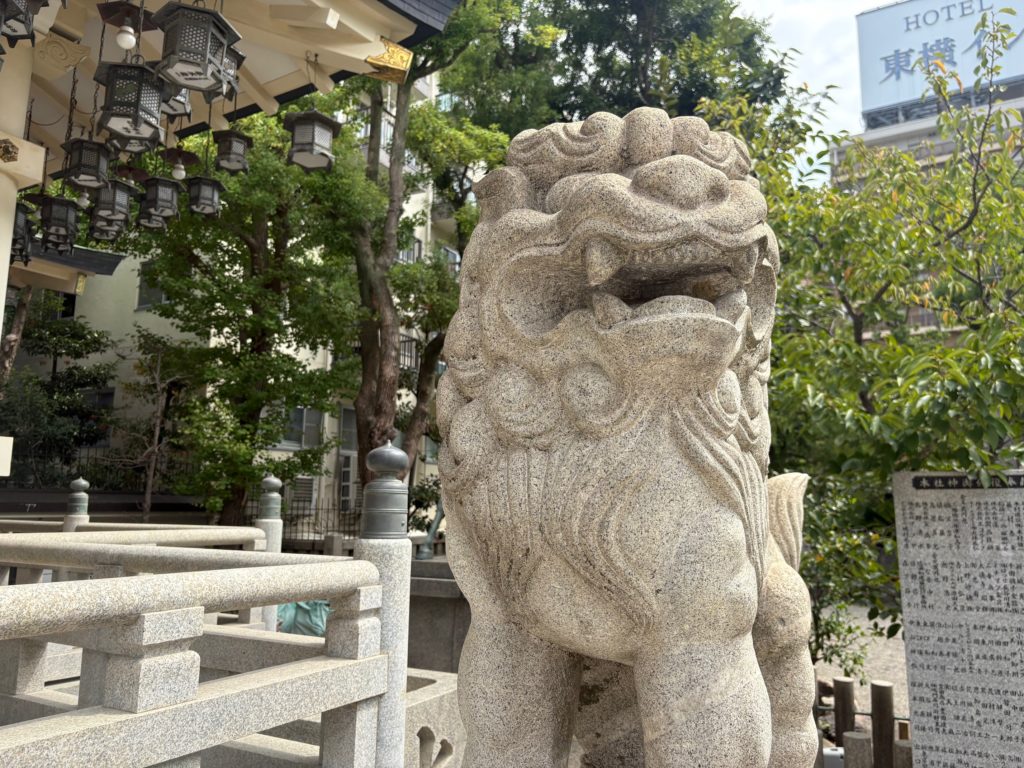
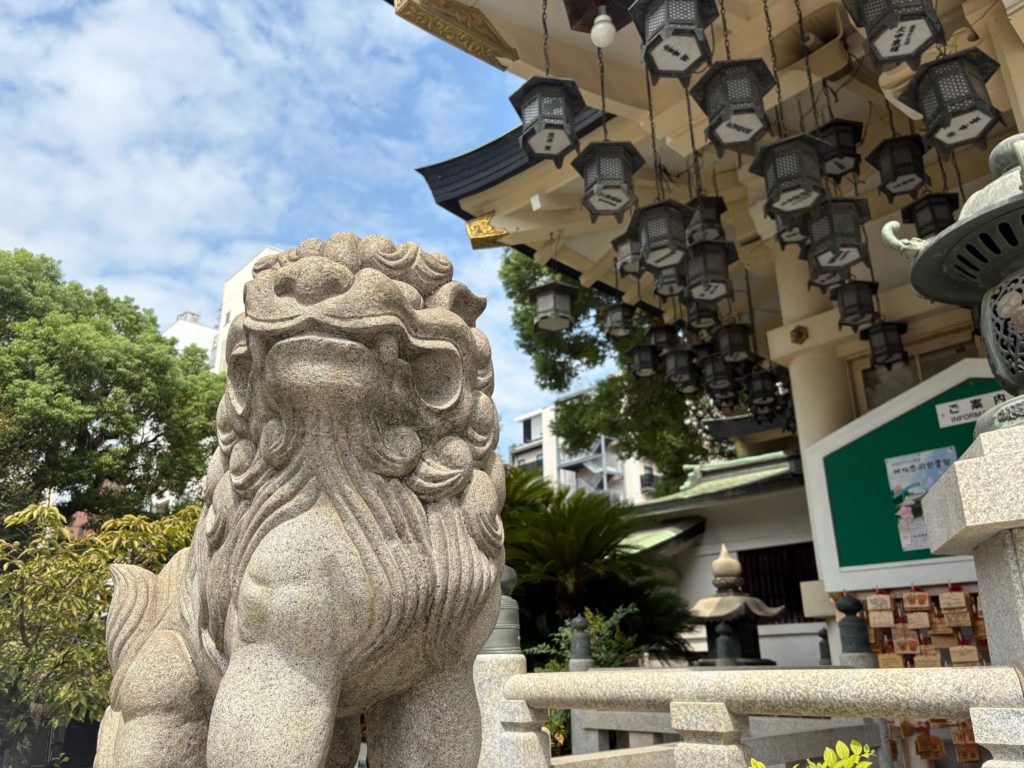
When visiting a Shinto shrine, you are always greeted by a pair of stone statues standing proudly before the main hall—these are the “Komainu.” Far from being mere decorations, their forms hold crucial roles as protectors of the sacred precinct, a profound history, and deep cultural meaning.
In this article, we will introduce the true nature of the Komainu, incorporating both common knowledge and academic perspectives.
🦁 1. The Komainu’s Role, and Why a Lion Became a “Dog”
The Komainu’s most vital mission is warding off evil spirits and guarding the sacred area.
With their powerful figures, they prevent misfortune from intruding upon the kami’s (gods’) domain.
【Academic Viewpoint】The Story of the Lion-Like Form Being Named “Dog”
The Komainu’s appearance closely resembles a lion (Shishi) with a mane. Why, then, is it named a “dog” (inu) in Japan?
- Origins as Lions: The roots of the Komainu lie in the ancient Orient’s lion statues, which were introduced to Japan alongside Buddhism.
- Naming Convention in the Imperial Court: Around the Heian period, when they were placed inside shrine buildings to ward off evil, a lineage of naming and sculpting arose to distinguish the pair: the statue with a horn on the left was called the “Komainu,” and the statue without a horn on the right was called the “Shishi (Lion).”
- However, this distinction fluctuated depending on the era, region, and artistic group. Later, the term “Komainu” became the general collective name for both.
- The Leading Etymology Theory: Due to the transmission route through the Korean Peninsula (Kōrai in Japanese), the theory that the name originated from “Kōrai-inu” (Kōrai dog) is one of the prevailing theories, but multiple theories coexist academically.
Thus, although their appearance is that of a lion, the name “Komainu” encapsulates the history of their transmission and Japan’s unique sculptural evolution.
🤫 2. The Secret of “A-Un”: The Symbol of the Universe and Life
The mouth shapes of the Komainu are always structured as a pair: the open-mouthed “A-gyō” and the closed-mouthed “Un-gyō.”
| Stance | Name | Mouth Shape | Traditional Placement |
| Open Mouth | A-gyō (Ah-form) | Open (Beginning) | Facing Right (General Rule) |
| Closed Mouth | Un-gyō (Un-form) | Closed (Conclusion) | Facing Left (General Rule) |
⚠️ Note: While “A-gyō on the right, Un-gyō on the left” is the general rule, exceptions where this placement is reversed are rare, depending on the region and the time of creation.
💫 The “A-Un” as Understood in Buddhism and Esoteric Buddhism
In Buddhism (especially Esoteric Buddhism), “A-Un” comes from the first sound (A) and the last sound (Hūṃ) in Sanskrit, and is interpreted as symbolizing “the entire universe” and “everything from the beginning (the initial sound) to the end (the conclusion).”
- A-gyō symbolizes “beginning and origin.”
- Un-gyō symbolizes “end and ultimate conclusion.”
【Popular Interpretation: From Birth to Death and Language】
This grand philosophy is commonly and widely popular among the Japanese people as concrete metaphors:
- The Relationship between the Syllabary and A-Un
- The metaphor that views the Japanese Go-jūon syllabary chart as a cycle starting with “A” and ending with “N” (Un) is widely cherished. However, establishing the direct origin of the system in A-Un requires academic caution.
- The Cycle of Human Life and Breath
- “A” is associated with the first cry a baby makes when born, or the image of exhaling.
- “Un” is associated with the final moment when one draws their last breath, or the image of inhaling.
- In this way, A-Un is thought to represent the entire cycle of human life (from birth to death) and breath (metaphorically) itself. This thought is also the origin of the phrase “A-un no Kokyū” (A-Un breathing), meaning two people working together in perfect harmony.
👶 3. Not Gender, But Symbolism: The “Cub-Carrying” and “Ball-Holding” Komainu
The ball (Hōju or sphere) or cub found at the feet of some Komainu are not indicators of gender but hold distinct symbolic meanings.
| Form | Symbolic Meaning | Note |
| Cub-Carrying Form | Motherhood, Fertility, Safe Childbirth | It is widely cherished as a symbol of motherhood. |
| Ball-Holding Form | Spiritual Power, Good Fortune, Authority | The ball is a “Hōju” (treasure jewel), symbolizing spiritual power or wish-fulfillment. |
【Important】Regarding Komainu Gender
The Komainu are fundamentally spiritual beasts and are not meant to possess biological gender differences. The paired statues are created to express Yin and Yang or duality. The cub-carrying Komainu should be viewed as a symbol of “motherhood” and “prosperity,” rather than a “mother,” which aligns more closely with academic and religious interpretations.
⛩️ Divine Messengers (Shinshi) in Place of Komainu
At some shrines, animals deeply connected to the enshrined deity guard the sacred area instead of Komainu. These are called “Shinshi” (Divine Messengers).
| Shrine (Enshrined Deity) | Divine Messenger (Shinshi) |
| Inari Shrine | Fox |
| Tenmangū Shrine | Ox/Cow |
| Hie Shrine / Sannō Shrine | Monkey |
💡 Conclusion: Read the Shrine’s Story Through the Komainu
The next time you visit a shrine, please don’t just walk past them. Take a moment to pause in front of the Komainu and reflect:
- Consider the historical background of the lion being called a “Komainu.”
- Check their mouths: Which one is the A-form and which is the Un-form, and are they reversed?
- Reflect on what the ball or the cub at their feet symbolizes.
Embedded within the form of each guardian is a history spanning thousands of years, along with deep philosophical and cultural meaning. Exploring the shrine with this knowledge will make your visit significantly richer.
| 【PR】 Your trip planning is almost complete! Complete your preparation by securing the one guide that guarantees confident interactions and a truly respectful experience in Japan. [Download the Essential Etiquette Guide] |