
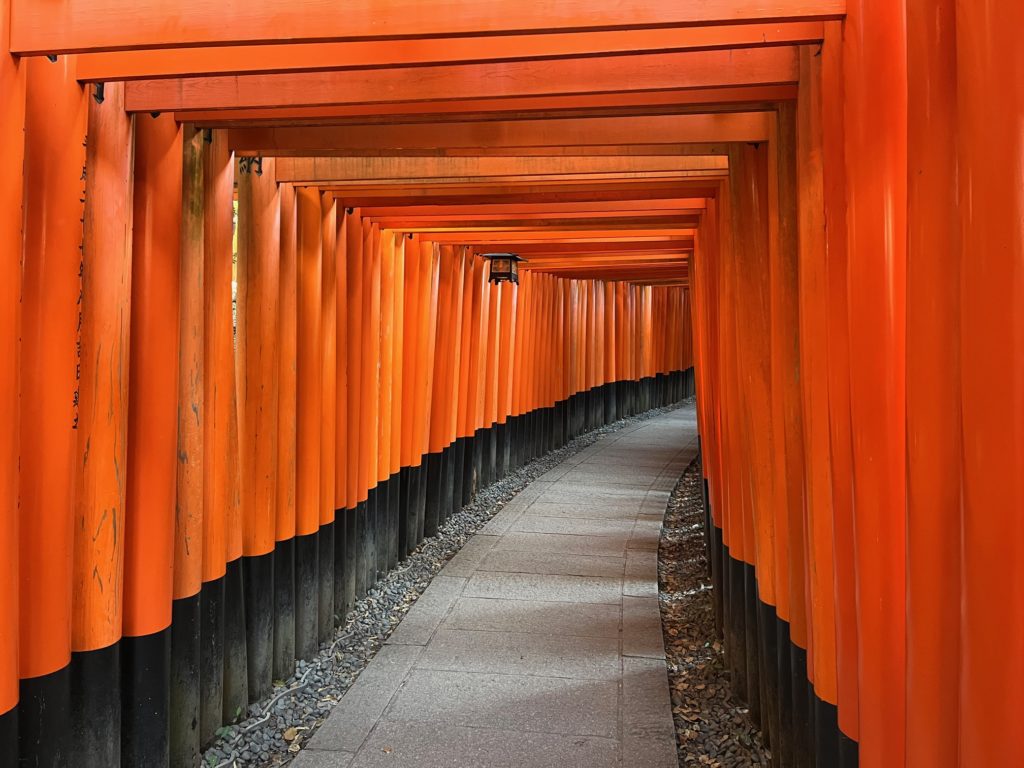
The sight of vibrant vermilion torii gates covering the mountain path is breathtaking. Fushimi Inari-Taisha in Kyoto has become a globally popular spot for its mysterious beauty.
However, if you leave this place thinking it’s only a “beautiful photo spot,” you will have missed the deep essence and the spirit of Japan that the shrine holds.
The Deity of Success and Prosperity
Fushimi Inari-Taisha is the Sōhongū (head shrine) for over 30,000 Inari Shrines across Japan.
The principal deity, Ukanomitama no Ōkami, was originally the god of rice and cereals.
Historically, rice was equivalent to wealth and property.
Therefore, over time, this deity came to be deeply revered as the god who brings “success in business and industry” (Shōbai Hanjō).
This is not just a place for sightseeing.
It is a “power spot for success and prosperity” where Japanese business people sincerely pray for the growth and achievement of their companies.
The Reason for the “Thousand” Gates
The iconic Senbon Torii (Thousand Torii) is not merely a beautiful decoration. It is a massive, physical monument that expresses “gratitude and wishes.”
Each single torii gate is a donation (contribution) made by an individual, or more often, by a Japanese corporation.
Look closely at the back of the gates. You will see the “name of the donor (company name)” and the “date of dedication” inscribed in black ink.
- The Meaning of Dedication: The custom of donating a torii as a “thank you” to the deity, in appreciation of a “wish passing through (being granted),” spread when someone succeeded in business or had a prayer answered.
- The “Passing” of Wishes: The continuous line of torii symbolizes a wish that is “passing through (being granted)” or one that has “passed through (been granted).”
Walking through this vermilion tunnel means literally walking through the history of Japanese business success and enduring hope for the future.
You will be profoundly moved when you understand that every single torii gate is a magnificent “thank you letter” written in wood.
The Truth of the Inari Mountain Pilgrimage: No Ranking in Divinity
As you proceed up Inari Mountain, you will reach spots called Ichi-no-mine (First Peak), Ni-no-mine (Second Peak), and San-no-mine (Third Peak), each housing a shinseki (sacred site where a deity is believed to reside or have descended).
This “O-yama Meguri” (mountain pilgrimage), circling the entire Inari Mountain, is a crucial form of worship passed down from ancient times.
The Origin of the Faith
Inari faith originally began with the “O-yama Shinkō” (Mountain Worship), where the mountain itself (especially its three peaks) was believed to house the gods.
The Misunderstood “Ranking”
Many people tend to assume that the deity at Ichi-no-mine (the mountain top) must hold the highest rank. However, this is not actually the case.
| Peak Name | Former Sacred Site | Key Point |
| San-no-mine (Closer to the base) | Lower Shrine Shinseki | The location where the Principal Deity (Ukanomitama no Ōkami) was originally enshrined. |
| Ichi-no-mine (Mountain Top) | Upper Shrine Shinseki | One of the locations where one of the five enshrined deities is worshipped. |
Currently, all five deities are enshrined together (gōshi – combined worship) in the main hall at the foot of the mountain.
The peaks on the mountain serve merely as the places where the deities are believed to have descended or as individual sacred sites.
There is no clear ranking that elevates the god at the mountain top. The current form of worship is to revere the five deities as a unified entity.
The Foxes: Messengers of the Deity
You will notice numerous fox (kitsune) statues across the grounds, often holding a key, a jewel, or a scroll in their mouths.
The fox is not the deity (Inari Ōkami) itself, but rather the deity’s “messenger.” They act as guardians of the shrine and deliver the deity’s blessings.
For Your Next Visit
Don’t just take a photo of the red gates. Pause, look at the names of the donors on the back of the torii. And when you make the pilgrimage, recognize the historical depth of the shrine—that the mountain top is not necessarily the most important location.
In doing so, you will realize you are standing in a magnificent open-air museum dedicated to Japanese enterprise, the spirit of gratitude, and the enduring hope for a prosperous life.
You Might Also Like
・Yasaka Shrine Kyoto: From Plague Prayers to Geisha Origins
・Chion-in Temple Kyoto: Hidden Gem & “The Last Samurai” Filming Location
| 【PR】 Your trip planning is almost complete! Complete your preparation by securing the one guide that guarantees confident interactions and a truly respectful experience in Japan. [Get the Kindle Edition Now on Amazon] |